
The Crew Strikes Back
A Cautionary Tale

Twelve years ago I’m walking through Gencon with Stephen Buonocore, and we pass by demos of the then-recently-released Star Trek: Catan. I jokingly say to him “You should really retheme some of your titles as a sci-fi game. Like a space version of Survive: Escape from Atlantis.” We both laugh and move on.
But a few weeks later he calls me and says - do you want to actually design that? Never one to back down from a challenge and a cash grab, I huddle up with my kids and we design what would be released in 2015 as Survive: Space Attack.
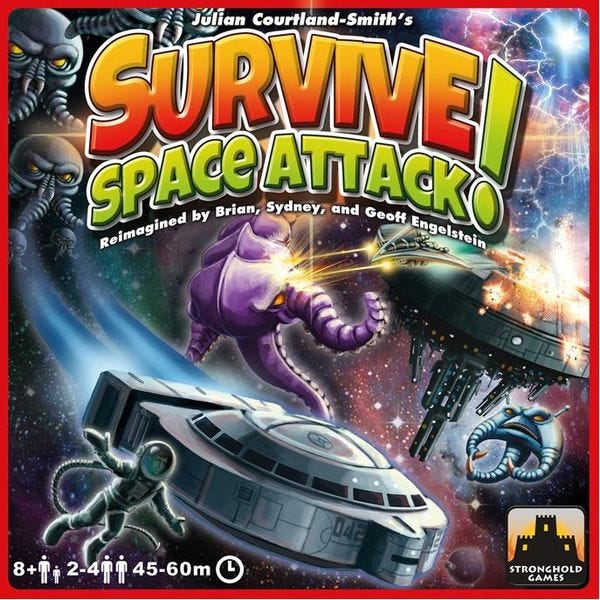
As an aside, I’m really proud of this game. The original Survive is a brilliant design, and we struggled to come up with meaningful changes to game play that didn’t just make things worse. But in the end, I think we nailed it.
As part of the release, Stronghold requested that we design a few mini-expansions. This was pretty late in the process, so we put together some quick ideas, including a small deck of one-use powers called The Crew Strikes Back that can be integrated into the game. They are themed as the crew of the space station, kind of a combination between the folks you’d find on a cruise ship or star base.
It was a fun little extra, and we had a good time developing the different roles and figuring out thematic powers. We turned it over to Stronghold, and they quickly banged out some artwork since - as mentioned - it was really late in the process. The three of us each individually looked over the cards, corrected some typos, but otherwise gave the thumbs up.
The game was launched in 2015, alongside the mini-expansion.
From a game-play standpoint it was well received (mostly 7’s on BGG), but the artwork was generally derided as being terrible, and not fitting with the vibe of the main game.
Here’s a link to a discussion: Terrible Artwork | BoardGameGeek
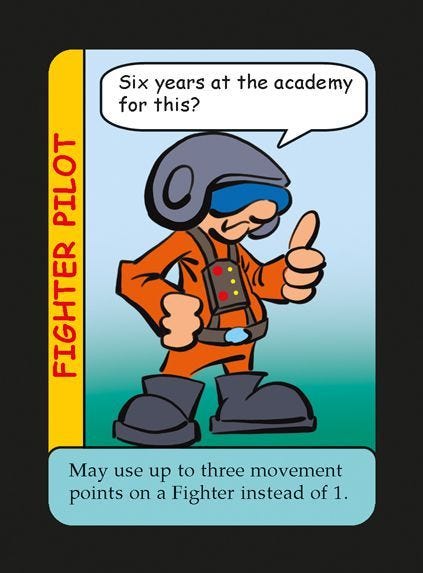
Here’s one of the cards:
Hardly any copies sold.
That would be the end of the story except that a few months after launch someone (I wish I could remember who) reached out to us and gently pointed out that on the twenty cards:
All 20 were white
18 were men
The two women were on the Maid card and the Aerobics Instructor card.
Yikes.
I was appalled. My son and daughter (both about 20 at the time) were appalled. Stronghold was appalled and quietly stopped selling them. There wasn’t enough of a demand to warrant a redesign and new printing.
There was no malice here at all. We gave no instructions to the artist as to what to draw. We just didn’t notice it when the art came back. Part of it was because we were in a rush, but that’s not an excuse. We all looked at it, and nobody saw anything out of the ordinary.
This is why awareness of these types of boneheaded moves is so important, and why people should loudly declare when it happens.
This is why showing your art to a diverse set of reviewers, or cultural consultants if you are focusing on a particular area, is critical.
Not because of bad intent, but just because we are often blind to these issues. We don’t perceive the water we swim in, as one person described it to me. To us having so many white male characters wasn’t ‘out of the ordinary’ because it was just… ordinary.
Shockingly no one called us out publicly at the time. They should have, honestly, and the fact that no one said anything either says something about how few people bought The Crew Strikes Back or what the game environment was like a mere ten years ago - or maybe both.
On our next game, The Dragon & Flagon, we put a big emphasis on making sure we had a diverse set of characters.
Our mage, Asma, was depicted as a young woman in a hijab, and she was on one of the large banners at the Stronghold booth in Gencon that year.
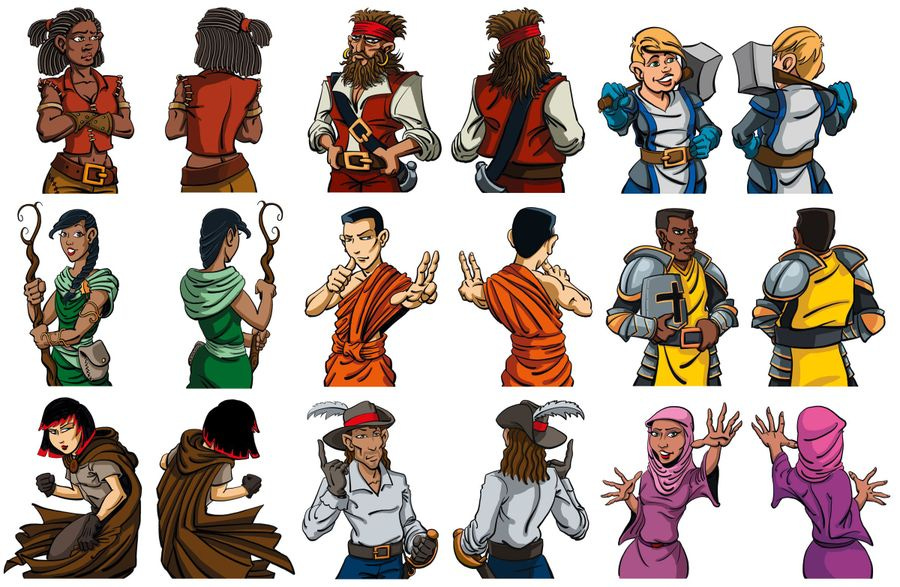
At one point a young girl in a hijab came into the booth after seeing Asma on the banner. She sat down and played a demo - playing that character of course - and I can still remember how incredibly excited she was to be represented in a game like that. It really moved me.
Even with the Dragon & Flagon, though, I feel we made a misstep with Teo, the monk character (centered in the image above). In retrospect I think it borders on orientalist stereotypes, and I wish we had had someone from that culture take a look. We did not, which is on me, although no one has ever raised it as far as I know.
I bring all this up, of course, in response to the game Ace of Spades from Devir, which was released at Gencon and included several offensive and racially insensitive portrayals on the cards. I won’t reproduce the images here, but you can read the full story on Board Game Wire.
I narrowly avoided a similar backlash on Crew mainly because no one bought the expansion, and it was ten years ago. But we all deserved it.
But I took the opportunity to learn and (hopefully) grow, and that effort continues with all of us.
I rarely bring up this story, as it’s embarrassing as hell and does not paint me in a good light. I do so now to illustrate that we are all vulnerable to making this mistake, and it requires vigilance. And also to recommend that we assume incompetence over malice when these issues (inevitably sadly) reoccur, until proven otherwise.
Here are the take-aways I took from my own incompetence, and I hope they prove useful to you as well:
If you are a designer or publisher, have a diverse group of people review your art, and use cultural consultants if warranted.
Make sure you give detailed instructions to your artists about ethnicities, body types, etc. Diversity doesn’t just ‘happen’.
Continue to raise your voice loudly and publicly, when you see something inappropriate.
Thanks for your honesty and humilty, Geoff. It can happen to any of us. My embarrassing moment was with my early card game Wampum. The prototype was about Native American tribes trading with each other, but the publisher made it about white settlers trading with Native Americans, and they changed one of the traded goods to "Good ol' Booze". I was in the middle of a move and glanzed at the artwork when they sent it to me, but it didn't occur to me until later, when I had more time to look at them again, that I had made a big mistake in not talking to the publisher about it. By the time I did, it was too late, the games were already being made. I was never so happy to have a game of mine go OOP (even though it got on Fairplay's top 10 list of card games and no one in Germany batted an eye about the theme). Looking back, of course, I would now enlist cultural consultants to help me with even using wampum for the theme. Everyone of us can learn, if we approach our work with openness and humility.